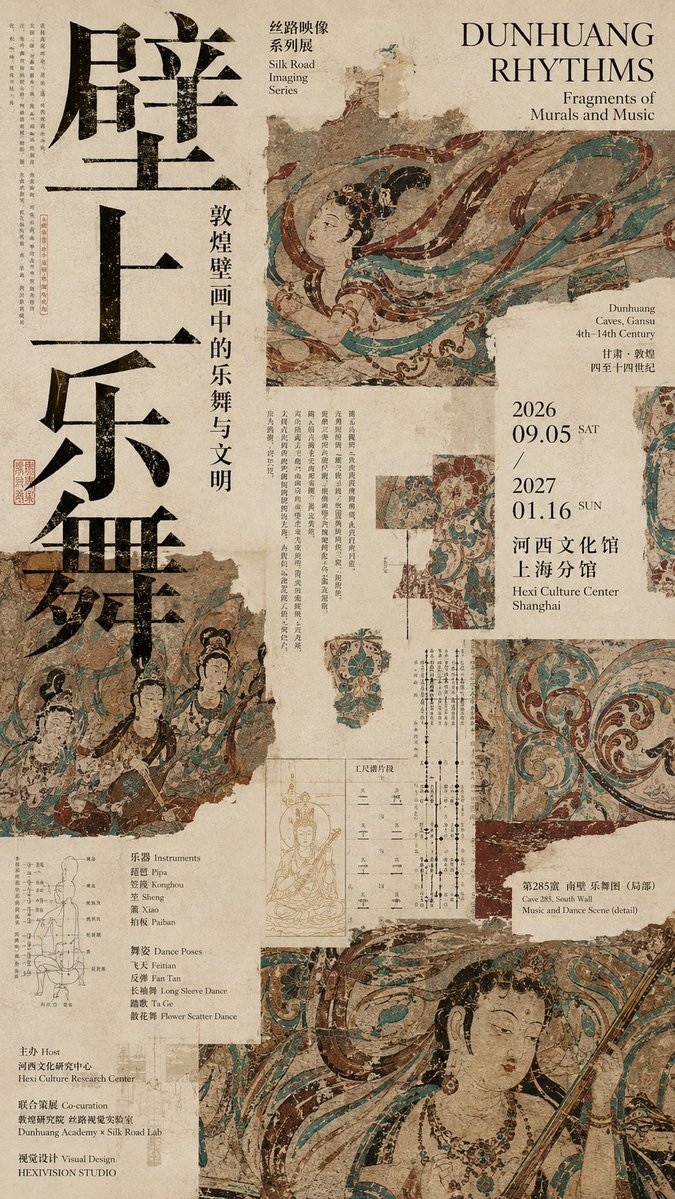
Dunhuang Rhythms Exhibition Poster
Creates a dense archival museum poster blending Dunhuang mural fragments, Chinese calligraphy, exhibition details, and editorial collage typography.
프롬프트
목표: {argument name="exhibition title" default="돈황의 리듬"}에 관한 밀도 높은 편집 디자인 문화 전시 포스터를 제작합니다. 돈황 벽화 파편, 음악 및 무용 기록 타이포그래피, 레이어드된 박물관 자료들을 결합하세요.

캔버스: 약 2:3 비율의 긴 세로형 포스터. 질감이 살아있는 오래된 따뜻한 베이지색 한지 배경으로, 얼룩, 찢어진 가장자리, 바랜 잉크, 콜라주 이음새가 보여야 합니다. 전반적인 분위기는 학구적이고 고고학적이며, 의도적으로 복잡하지만 강력한 그리드를 갖춘 고도의 디자인이어야 합니다.

레이아웃: 비대칭 고밀도 콜라주를 사용하세요. 맨 왼쪽에는 거의 전체 높이를 차지하는 4개의 거대한 검은색 중국 서예 글자 「벽상악무(壁上乐舞)」를 배치하고, 잉크 질감이 느껴지는 낡은 느낌을 주세요. 큰 글자 옆에는 「돈황 벽화 속의 음악과 무용, 그리고 문명(敦煌壁画中的乐舞与文明)」이라는 좁은 세로형 중국어 부제를 추가하세요. 왼쪽 상단 중앙에는 작은 이중 언어 시리즈 라벨인 「실크로드 영상 시리즈(丝路映像 系列展)」와 그 아래에 “Silk Road Imaging Series”를 넣으세요. 오른쪽 상단에는 우아한 세리프 대문자로 메인 영문 타이틀 “DUNHUANG RHYTHMS”를 배치하고, 그 아래에 더 작은 부제 “Fragments of Murals and Music”을 넣으세요.

주요 이미지: 터키석색, 진사색, 황토색, 검은색, 양피지 베이지색 등 바랜 돈황 동굴 벽화 색상을 사용하여 6개의 벽화/이미지 파편을 배치하세요: 1) 오른쪽 상단에 대각선으로 리본이 흐르는 비천상 악사 파편; 2) 왼쪽 하단에 3명의 벽화 속 악사나 무용수가 보이는 찢어진 파편; 3) 오른쪽 중앙에 서 있는 무용수가 담긴 작은 직사각형 파편; 4) 중앙 하단에 화려한 꽃무늬 스크롤 패턴 파편; 5) 오른쪽 하단에 보살이나 비천의 얼굴, 장신구, 흐르는 리본이 담긴 대형 클로즈업 파편; 6) 오른쪽 가장자리에 잘린 세로형 벽화 조각. 파편들은 균열, 탈락된 석고, 칩이 있는 가장자리, 불균일한 불투명도를 가진 스캔된 고대 벽화처럼 보여야 합니다.

정보 블록: 콜라주 주변, 특히 맨 왼쪽 여백, 중앙 열, 하단 중앙에 박물관 메모나 기록 캡션 같은 얇은 세로형 중국어 텍스트 열을 많이 추가하세요. 4개의 주요 정보 패널을 포함하세요: 1) 오른쪽의 날짜 및 장소 패널 (“2026 09.05 SAT / 2027 01.16 SUN”, 중국어 장소 텍스트, “Hexi Culture Center Shanghai”); 2) 왼쪽 하단의 교육용 패널 (“악기” 및 “무용 동작” 목록과 악기 선화); 3) 왼쪽 하단의 주최/크레딧 패널 (주최, 협력, 비주얼 디자인 라인 포함); 4) 오른쪽 하단의 동굴 캡션 패널 (“285번 동굴, 남벽 음악 및 무용 장면 (세부)” 및 그 위의 중국어).

타이포그래피 및 스타일: 거친 검은색 중국어 붓글씨, 세련된 서양식 세리프 대문자, 작은 중국어 송/명조체 세로 텍스트, 아주 작은 영어 박물관 캡션을 혼합하세요. 검은색, 짙은 갈색, 바랜 붉은색 스탬프 잉크, 가끔 보이는 바랜 그리드 표시를 사용하세요. 작은 붉은색 낙관, 얇은 기록용 도표, 희미한 측정선, 여백 주석을 추가하세요. 현대적인 박물관 포스터, 편집 잡지 지면, 역사 기록 보관소가 융합된 느낌을 주어야 합니다.

제약 사항: 밀도 높은 콜라주 속에서도 전시 포스터로서의 명확한 위계를 유지하세요. 현대적인 광택 느낌은 피하고, 모든 요소는 무광택, 노후화, 풍화된 느낌으로 질감이 있는 종이에 인쇄된 것처럼 표현하세요. 벽화 파편 외에 실사 인물은 사용하지 말고, 3D 효과, 밝은 네온 컬러, 깨끗한 빈 흰색 배경은 사용하지 마세요. 가장 눈에 띄게 읽혀야 할 텍스트는 「벽상악무(壁上乐舞)」, {argument name="Chinese subtitle" default="돈황 벽화 속의 음악과 무용, 그리고 문명"}, “DUNHUANG RHYTHMS”, 그리고 날짜 범위 {argument name="exhibition dates" default="2026 09.05 / 2027 01.16"}입니다.
기계 번역 — 실제 결과물을 만든 것은 원문 프롬프트입니다.
원문 프롬프트
Goal: Create a dense editorial cultural-exhibition poster about {argument name="exhibition title" default="Dunhuang Rhythms"}, combining Dunhuang mural fragments, music-and-dance archive typography, and layered museum ephemera.

Canvas: Tall vertical poster, approximately 2:3 ratio, aged warm beige rice-paper background with visible grain, stains, torn edges, faded ink, and pasted-collage seams. Overall mood is scholarly, archaeological, and highly designed, with intentional clutter but a strong grid.

Layout: Use an asymmetric high-density collage. On the far left, place four enormous stacked black Chinese calligraphy characters reading 「壁上乐舞」, occupying nearly the full height, distressed and ink-textured. Beside the large characters, add a narrow vertical Chinese subtitle reading 「敦煌壁画中的乐舞与文明」. At the top center-left, add a small bilingual series label: 「丝路映像 系列展」 with “Silk Road Imaging Series” underneath. At the top right, place the main English title in elegant serif capitals: “DUNHUANG RHYTHMS”, with the smaller subtitle “Fragments of Murals and Music” below.

Main imagery: Use exactly 6 visible mural/image fragments, all in faded Dunhuang cave-painting colors of turquoise, cinnabar red, ochre, black, and parchment beige: 1) a large upper-right flying apsara musician fragment with flowing ribbons crossing diagonally; 2) a lower-left torn fragment showing three mural musicians or dancers; 3) a mid-right small rectangular fragment of a standing dancer; 4) a mid-lower ornate floral scroll pattern fragment; 5) a large bottom-right close-up of a female bodhisattva or apsara face with jewelry and flowing ribbons; 6) a right-edge partial vertical mural strip cropped off the page. Make the fragments look like scanned ancient wall paintings with cracks, missing plaster, chipped edges, and uneven opacity.

Information blocks: Add many thin vertical Chinese text columns like museum notes and archival captions around the collage, especially along the far left margin, middle columns, and lower center. Include exactly 4 primary info panels: 1) a right-side date and venue panel with “2026 09.05 SAT / 2027 01.16 SUN”, Chinese venue text, and “Hexi Culture Center Shanghai”; 2) a lower-left educational panel listing “Instruments” and “Dance Poses” with a small line drawing of an instrument; 3) a bottom-left organizer/credits panel with Host, Co-operation, and Visual Design lines; 4) a lower-right cave caption panel reading “Cave 285, South Wall Music and Dance Scene (detail)” with Chinese above it.

Typography and style: Mix oversized rough black Chinese brush type, refined Western serif uppercase, small Chinese Song/Ming-style vertical text, and tiny English museum captions. Use black, dark brown, muted red stamp ink, and occasional faded grid marks. Add small red seal stamps, thin archival diagrams, faint measurement lines, and marginal annotations. The design should feel like a contemporary museum poster, editorial magazine spread, and historical archive board fused together.

Constraints: Preserve a clear exhibition-poster hierarchy despite the dense collage. Do not make it modern glossy; keep everything matte, aged, weathered, and printed on textured paper. Use no photorealistic people outside the mural fragments, no 3D effects, no bright neon colors, and no empty clean white background. The most prominent readable texts should be 「壁上乐舞」, {argument name="Chinese subtitle" default="敦煌壁画中的乐舞与文明"}, “DUNHUANG RHYTHMS”, and the date range {argument name="exhibition dates" default="2026 09.05 / 2027 01.16"}.