Dunhuang Rhythms Exhibition Poster
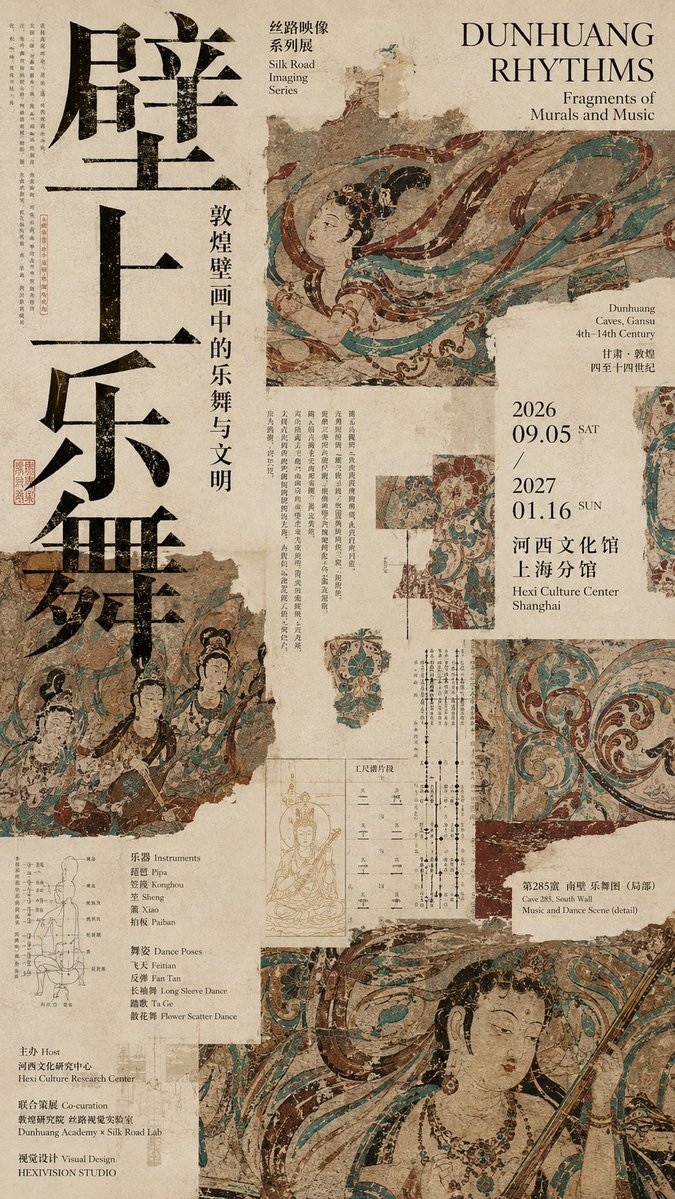
Creates a dense archival museum poster blending Dunhuang mural fragments, Chinese calligraphy, exhibition details, and editorial collage typography.
Prompt
Objetivo: Criar um pôster de exposição cultural editorial denso sobre {argument name="exhibition title" default="Ritmos de Dunhuang"}, combinando fragmentos de murais de Dunhuang, tipografia de arquivo de música e dança, e efêmeras de museu em camadas.

Tela: Pôster vertical alto, proporção de aproximadamente 2:3, fundo de papel de arroz bege quente envelhecido com granulação visível, manchas, bordas rasgadas, tinta desbotada e costuras de colagem. O clima geral é acadêmico, arqueológico e altamente projetado, com uma desordem intencional, mas mantendo uma grade forte.

Layout: Use uma colagem assimétrica de alta densidade. Na extrema esquerda, coloque quatro enormes caracteres de caligrafia chinesa empilhados lendo 「壁上乐舞」, ocupando quase toda a altura, com aspecto desgastado e textura de tinta. Ao lado dos grandes caracteres, adicione um subtítulo chinês vertical estreito lendo 「敦煌壁画中的乐舞与文明」. No centro-superior esquerdo, adicione um pequeno rótulo de série bilíngue: 「丝路映像 系列展」 com “Silk Road Imaging Series” logo abaixo. No canto superior direito, coloque o título principal em inglês em letras maiúsculas serifadas elegantes: “DUNHUANG RHYTHMS”, com o subtítulo menor “Fragments of Murals and Music” abaixo.

Imagens principais: Use exatamente 6 fragmentos visíveis de murais/imagens, todos nas cores desbotadas das pinturas das cavernas de Dunhuang: turquesa, vermelho cinábrio, ocre, preto e bege pergaminho: 1) um grande fragmento de músico apsara voador no canto superior direito com fitas fluidas cruzando diagonalmente; 2) um fragmento rasgado no canto inferior esquerdo mostrando três músicos ou dançarinos do mural; 3) um pequeno fragmento retangular no meio à direita de um dançarino em pé; 4) um fragmento de padrão de voluta floral ornamentado no meio inferior; 5) um grande close-up no canto inferior direito do rosto de um bodhisattva ou apsara feminino com joias e fitas fluidas; 6) uma faixa vertical parcial do mural na borda direita cortada da página. Faça com que os fragmentos pareçam pinturas murais antigas digitalizadas com rachaduras, reboco faltando, bordas lascadas e opacidade irregular.

Blocos de informações: Adicione muitas colunas verticais finas de texto em chinês, como notas de museu e legendas de arquivo ao redor da colagem, especialmente ao longo da margem esquerda, colunas centrais e centro inferior. Inclua exatamente 4 painéis de informações principais: 1) um painel de data e local no lado direito com “2026 09.05 SAT / 2027 01.16 SUN”, texto do local em chinês e “Hexi Culture Center Shanghai”; 2) um painel educacional no canto inferior esquerdo listando “Instruments” e “Dance Poses” com um pequeno desenho de um instrumento; 3) um painel de organizador/créditos no canto inferior esquerdo com linhas de Host, Co-operation e Visual Design; 4) um painel de legenda da caverna no canto inferior direito lendo “Cave 285, South Wall Music and Dance Scene (detail)” com chinês acima.

Tipografia e estilo: Misture tipos de pincel chinês ásperos e grandes, letras maiúsculas serifadas ocidentais refinadas, texto vertical chinês estilo Song/Ming e pequenas legendas de museu em inglês. Use preto, marrom escuro, tinta de carimbo vermelha suave e marcas de grade desbotadas ocasionais. Adicione pequenos carimbos vermelhos, diagramas de arquivo finos, linhas de medição tênues e anotações marginais. O design deve parecer uma fusão entre um pôster de museu contemporâneo, uma página de revista editorial e um quadro de arquivo histórico.

Restrições: Preserve uma hierarquia clara de pôster de exposição, apesar da colagem densa. Não faça com que pareça moderno e brilhante; mantenha tudo fosco, envelhecido, desgastado e impresso em papel texturizado. Não use pessoas fotorrealistas fora dos fragmentos do mural, sem efeitos 3D, sem cores neon brilhantes e sem fundo branco limpo e vazio. Os textos legíveis mais proeminentes devem ser 「壁上乐舞」, {argument name="Chinese subtitle" default="敦煌壁画中的乐舞与文明"}, “DUNHUANG RHYTHMS” e o intervalo de datas {argument name="exhibition dates" default="2026 09.05 / 2027 01.16"}.
Tradução automática — o prompt original é o que gerou este resultado.
Prompt original
Goal: Create a dense editorial cultural-exhibition poster about {argument name="exhibition title" default="Dunhuang Rhythms"}, combining Dunhuang mural fragments, music-and-dance archive typography, and layered museum ephemera.

Canvas: Tall vertical poster, approximately 2:3 ratio, aged warm beige rice-paper background with visible grain, stains, torn edges, faded ink, and pasted-collage seams. Overall mood is scholarly, archaeological, and highly designed, with intentional clutter but a strong grid.

Layout: Use an asymmetric high-density collage. On the far left, place four enormous stacked black Chinese calligraphy characters reading 「壁上乐舞」, occupying nearly the full height, distressed and ink-textured. Beside the large characters, add a narrow vertical Chinese subtitle reading 「敦煌壁画中的乐舞与文明」. At the top center-left, add a small bilingual series label: 「丝路映像 系列展」 with “Silk Road Imaging Series” underneath. At the top right, place the main English title in elegant serif capitals: “DUNHUANG RHYTHMS”, with the smaller subtitle “Fragments of Murals and Music” below.

Main imagery: Use exactly 6 visible mural/image fragments, all in faded Dunhuang cave-painting colors of turquoise, cinnabar red, ochre, black, and parchment beige: 1) a large upper-right flying apsara musician fragment with flowing ribbons crossing diagonally; 2) a lower-left torn fragment showing three mural musicians or dancers; 3) a mid-right small rectangular fragment of a standing dancer; 4) a mid-lower ornate floral scroll pattern fragment; 5) a large bottom-right close-up of a female bodhisattva or apsara face with jewelry and flowing ribbons; 6) a right-edge partial vertical mural strip cropped off the page. Make the fragments look like scanned ancient wall paintings with cracks, missing plaster, chipped edges, and uneven opacity.

Information blocks: Add many thin vertical Chinese text columns like museum notes and archival captions around the collage, especially along the far left margin, middle columns, and lower center. Include exactly 4 primary info panels: 1) a right-side date and venue panel with “2026 09.05 SAT / 2027 01.16 SUN”, Chinese venue text, and “Hexi Culture Center Shanghai”; 2) a lower-left educational panel listing “Instruments” and “Dance Poses” with a small line drawing of an instrument; 3) a bottom-left organizer/credits panel with Host, Co-operation, and Visual Design lines; 4) a lower-right cave caption panel reading “Cave 285, South Wall Music and Dance Scene (detail)” with Chinese above it.

Typography and style: Mix oversized rough black Chinese brush type, refined Western serif uppercase, small Chinese Song/Ming-style vertical text, and tiny English museum captions. Use black, dark brown, muted red stamp ink, and occasional faded grid marks. Add small red seal stamps, thin archival diagrams, faint measurement lines, and marginal annotations. The design should feel like a contemporary museum poster, editorial magazine spread, and historical archive board fused together.

Constraints: Preserve a clear exhibition-poster hierarchy despite the dense collage. Do not make it modern glossy; keep everything matte, aged, weathered, and printed on textured paper. Use no photorealistic people outside the mural fragments, no 3D effects, no bright neon colors, and no empty clean white background. The most prominent readable texts should be 「壁上乐舞」, {argument name="Chinese subtitle" default="敦煌壁画中的乐舞与文明"}, “DUNHUANG RHYTHMS”, and the date range {argument name="exhibition dates" default="2026 09.05 / 2027 01.16"}.
✨ Gerar Salvar Publicação original Abrir no Hitboard