豬排飯烹飪分鏡
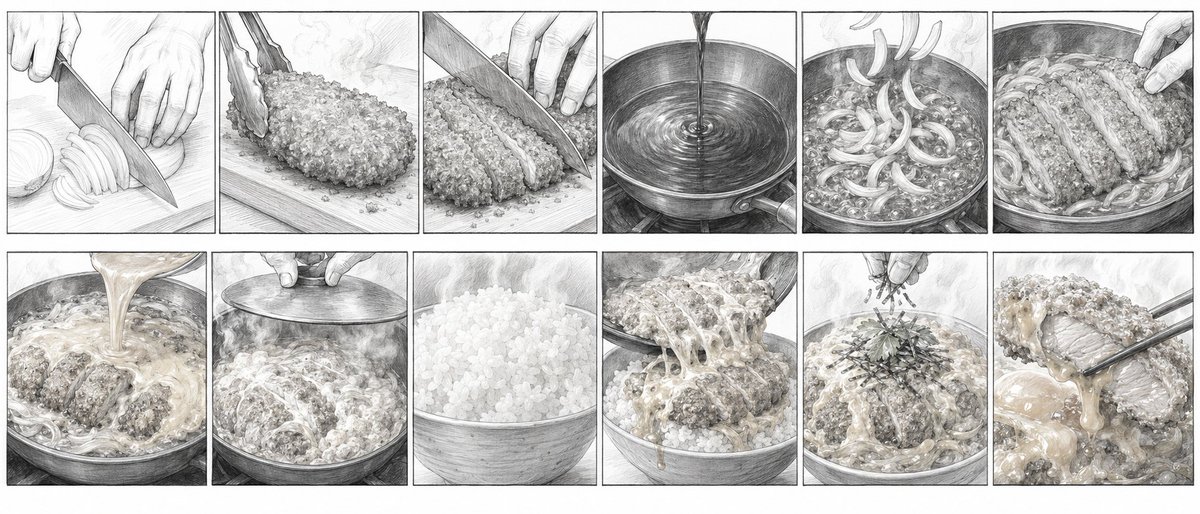
A detailed 12-panel manga-style recipe storyboard showing the full cooking process for katsudon from onion slicing to serving.
Prompt
目標:創作一本單色烹飪分鏡腳本插圖,展示日式炸猪排丼飯的準備和上菜過程,繪製風格類似詳細的漫畫分鏡腳本或食譜流程圖。

畫布:寬橫幅比例,約 2.4:1,白色背景,精確排列為 12 個矩形格子,以整潔的網格佈置:頂行 6 格,底行 6 格。每個格子之間有細黑線分隔。無說明文字、無對話框、無標誌、無浮水印。

視覺風格:高度細節的鉛筆素描和淡彩水洗效果,主要為灰階色調,蛋液醬汁和炸排帶有細微的溫暖米色調。精細的交叉陰影線、可見的紙張紋理、寫實的手繪食物質感、蒸汽、油和醬汁的光澤,每格都採用電影感的特寫構圖。

主題:展示 {argument name="dish name" default="炸猪排丼"} 的逐步烹飪過程,包含切片洋麵包屑豬排、燉煮的蛋液醬汁、米飯和配料。當手部出現時,使用寫實的成人手部特寫,緊貼食物。

格子佈局與精確格子數:精確展示 12 格,從左到右、頂行再到底行順序:
1. 特寫雙手在砧板上用大廚刀將淺色洋蔥切成薄月牙片。
2. 特寫放在砧板上的麵包屑豬排,用夾子夾著,表面覆蓋粗糙酥脆的麵包屑。
3. 特寫用刀將炸好的豬排切成厚片,手指穩穩按住。
4. 頂視特寫,將清湯或高湯倒入圓形金屬鍋中,形成漣漪。
5. 特寫切片洋蔥在冒泡的高湯中燉煮,蒸汽升騰。
6. 特寫用手將切好的豬排片放在鍋中洋蔥的上面。
7. 特寫將打散的蛋液混合物倒在豬排和洋蔥上,奶油色的蛋絲在鍋中蔓延。
8. 特寫一個金屬鍋蓋蓋在鍋上,蒸汽從邊緣冒出。
9. 特寫一個盛滿蓬鬆白米飯的大碗,米粒清晰可見。
10. 特寫煮好的豬排、洋蔥和柔軟的蛋液混合物從鍋中滑到米飯碗上,蛋絲拉長。
11. 特寫完成的碗上撒上薄薄的深色海苔條和綠色配料,蒸汽升騰。
12. 特寫上菜鏡頭,筷子夾起一片沾著醬汁、蛋液滴落的豬排片,下方可見米飯碗。

構圖限制:保持每格緊湊構圖,以食物為焦點;所有格子保持一致的照明和手繪鉛筆陰影;確保序列可讀為食譜分鏡腳本;不添加文字標籤、編號、額外格子、未描述的餐具或色彩鮮豔的現代圖形。
機器翻譯 — 實際產出作品的是原文 prompt。
原文 Prompt
Goal: Create a monochrome cooking storyboard illustration showing the preparation and serving of a Japanese-style katsudon rice bowl, drawn like a detailed manga storyboard or recipe process sheet.

Canvas: Wide horizontal aspect ratio, about 2.4:1, white background, arranged as exactly 12 rectangular panels in a clean grid: 6 panels across the top row and 6 panels across the bottom row. Thin black borders separate every panel. No captions, no speech bubbles, no logos, no watermark.

Visual style: Highly detailed pencil sketch and light watercolor-wash look, mostly grayscale with subtle warm beige tones in the egg sauce and fried cutlet. Fine crosshatching, visible paper texture, realistic hand-drawn food textures, steam, highlights on oil and sauce, cinematic close-up framing in every panel.

Subject: A step-by-step cooking sequence for {argument name="dish name" default="katsudon"}, featuring sliced onion, breaded pork cutlet, simmering egg sauce, rice, and garnish. Use realistic adult hands when hands appear, cropped close to the food.

Panel layout and exact panel count: Show exactly 12 panels, ordered left to right, top row then bottom row:
1. Close-up of hands slicing a pale onion into thin crescent slices on a cutting board with a large kitchen knife.
2. Close-up of a breaded pork cutlet on a cutting board, held with tongs, covered in coarse crispy crumbs.
3. Close-up of the fried cutlet being cut into thick strips with a knife, fingers holding it steady.
4. Top-down close-up of clear liquid or broth being poured into a round metal pan, creating circular ripples.
5. Close-up of sliced onions simmering in bubbling broth in the pan, steam rising.
6. Close-up of the sliced cutlet being placed on top of the onions in the pan by hand.
7. Close-up of beaten egg mixture being poured over the cutlet and onions, creamy ribbons spreading through the pan.
8. Close-up of a metal lid covering the pan while steam surrounds the edges.
9. Close-up of a large bowl filled with fluffy white rice, rice grains clearly defined.
10. Close-up of the cooked cutlet, onion, and soft egg mixture being slid from the pan onto the rice bowl, strands of egg stretching.
11. Close-up of the finished bowl being sprinkled with thin dark seaweed strips and green garnish on top, steam rising.
12. Close-up serving shot of chopsticks lifting one saucy slice of cutlet with soft egg dripping, the rice bowl visible underneath.

Composition constraints: Keep each panel tightly framed and food-focused; maintain consistent lighting and hand-drawn pencil shading across all panels; make the sequence readable as a recipe storyboard; do not add text labels, numbers, extra panels, utensils not described, or colorful modern graphics.