Idol Dance Pose Sequence
觀看97,698
按讚934
留言18
分享92
書籤1,091
引用8
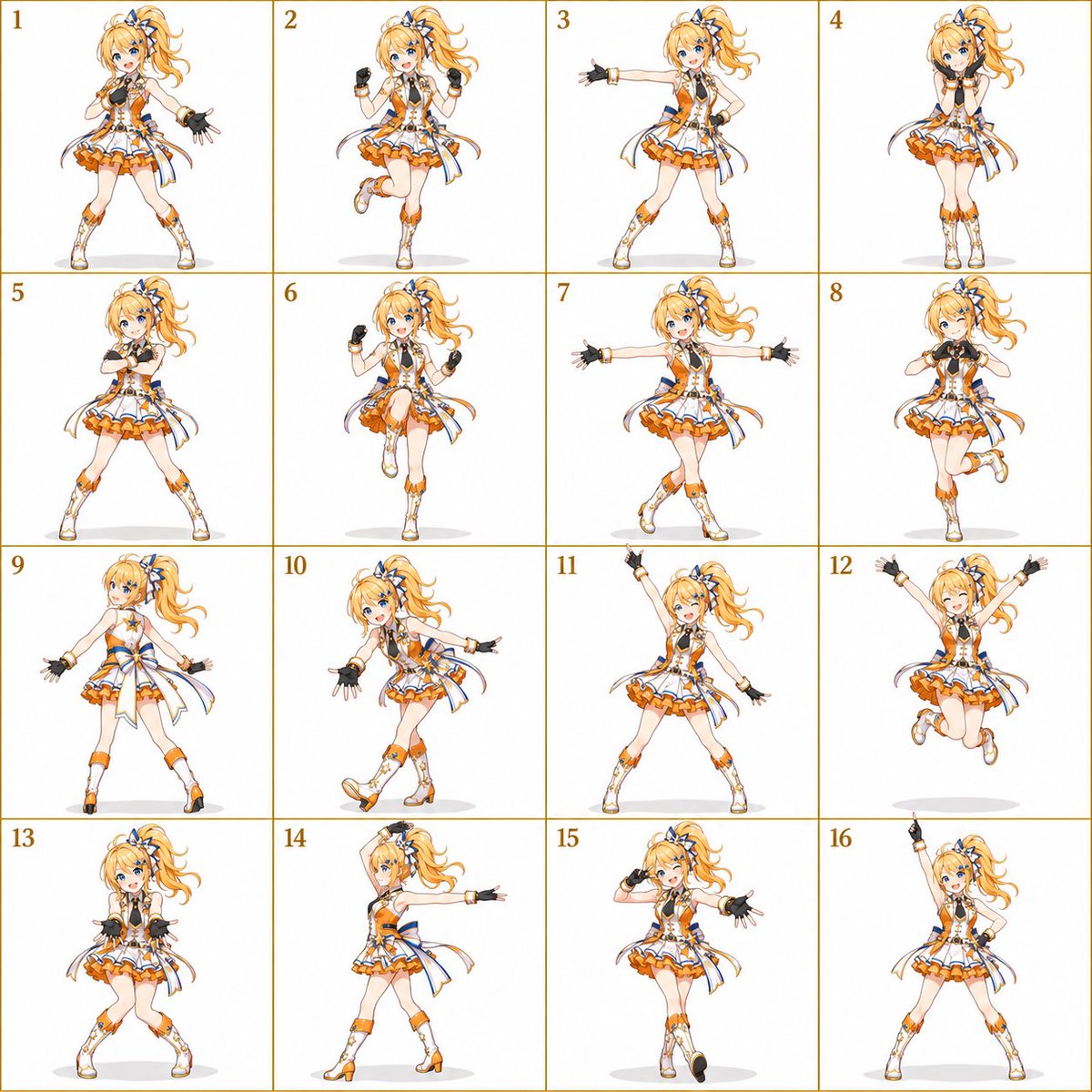
Create a 4×4 dance pose sheet featuring the character in the uploaded reference image, with exactly 16 equally sized panels in one square image.

CHARACTER CONSISTENCY
Use the uploaded character as the sole reference for character identity and appearance. Preserve the character’s face, hairstyle, colors, body proportions, species, outfit, accessories, and original art style across all 16 panels. Do not redesign the character or add an idol costume. If any body or costume details are not visible in the reference, infer them conservatively and keep them consistent throughout.

ADAPTIVE CHOREOGRAPHY
Design a cohesive dance sequence tailored to this specific character’s personality, appearance, anatomy, clothing, and range of motion. Choose a suitable dance style automatically: lively for an energetic character, graceful for an elegant character, confident for a bold character, playful for a cute character, or restrained for a serious character. Do not force every character into cute idol poses.

Show 16 distinct key poses from the same dance routine, ordered from left to right and top to bottom. Make the sequence feel connected, with natural transitions and a clear beginning, build-up, climax, and ending.

Use the following movement structure, adapting each action to the character:
1. Opening pose that establishes the character’s personality.
2. Small rhythmic step with a coordinated arm gesture.
3. Side step with one arm extended.
4. Compact expressive gesture near the face or upper body.
5. Grounded stance with arms crossing or sweeping inward.
6. Knee lift or an anatomically appropriate weight shift.
7. Open, expansive pose with arms spread.
8. Playful or expressive balance pose.
9. Turning pose showing a three-quarter rear view.
10. Forward-reaching movement with a diagonal body lean.
11. Strong upward-reaching accent.
12. Climactic jump or a grounded full-body extension if jumping is unsuitable.
13. Lowered stance with a forward gesture.
14. Elegant or dynamic side-facing transition.
15. Signature gesture that suits the character.
16. Confident final pose with a clear finishing silhouette.

COMPOSITION AND PRESENTATION
Use a clean white background, thin grid lines, and small readable numbers 1–16 in the upper-left corner of each panel. Include exactly one full-body depiction of the same character per panel. Keep the character’s scale, camera distance, lighting, and rendering style consistent. Use a fixed camera while allowing the character to turn naturally.

Keep the entire character, including hair, ears, horns, wings, tail, hands, feet, and accessories, inside each panel with comfortable margins. Allow room for extended limbs and jumps. Add subtle ground shadows. Show natural secondary movement in hair, fabric, and accessories.

Every pose must have a clear silhouette, convincing balance, anatomically plausible joints, and expressive body language. Adapt all movements to nonhuman anatomy when applicable.

AVOID
Repeated or nearly identical poses, character identity drift, costume changes, inconsistent proportions, extra or missing limbs, malformed hands, cropped body parts, overlapping panels, additional characters, motion trails, background scenery, props not present in the reference, speech bubbles, captions, and watermarks.

Final output: one polished square image containing a clearly organized 4×4 grid of 16 distinct, character-appropriate dance poses.

Use this sheet for character appearance and choreography. Follow poses 1→16 from left to right, top to bottom, connecting them into one continuous dance.

Create a continuous 2D anime animation of one cheerful idol dancing in a plain white space. Preserve her golden-blonde high side ponytail, curled hair tips, bright blue eyes, navy-white-and-gold star hair bow, small star hair clips, orange-and-white fitted stage vest, black necktie, gold trim and star ornaments, white pleated skirt with navy edging and orange ruffles, long waist ribbons, black fingerless gloves, and tall white boots with orange cuffs and gold stars. Match the reference’s body proportions, crisp outlines, vibrant colors, and clean cel shading. Keep her face, hairstyle, costume, and accessories consistent. No microphone or handheld props.

Her performance is bright, playful, and confident, combining lively idol gestures, rhythmic steps, heart-shaped hands, light hops, and a triumphant finishing pose. Use natural smiles and occasional winks.

Use a fixed front-facing camera in one uninterrupted full-body shot. Start immediately in pose 1. Keep her entire silhouette, including raised fingers, ponytail, ribbons, and boot soles, inside the frame with comfortable white margins. A soft light-gray oval shadow grounds her feet and remains on the floor during jumps.

The grid defines choreography order only. Show one character in one continuous space. No reference sheet, split screens, borders, numbers, captions, duplicate figures, afterimages, cuts, or camera movement.

Each numbered pose occupies 0.5 seconds. Clearly articulate its silhouette, then transition through natural movement into the next. Maintain continuous anatomy and weight transfer: feet push off and land, knees absorb impact, and hips and shoulders guide turns. Her ponytail, skirt ruffles, and ribbons follow with slightly delayed motion. Avoid slideshow transitions, morphing, foot sliding, or sudden changes in limb position. Match the actual numbered reference silhouettes whenever wording is ambiguous. All directions below refer to the viewer’s screen.

0.0–0.5 seconds — Pose 1
Begin facing forward with feet apart, one hand over her chest and the opposite arm extended low toward screen right, palm open in welcome. Smile brightly. Bounce softly through her knees, then draw both elbows inward and raise her hands.

0.5–1.0 seconds — Pose 2
Hold both fists near shoulder height with elbows bent. Balance on the leg on screen right while bending the other leg backward, heel lifted. Add a buoyant shoulder accent, then lower the lifted foot into a wider stance.

1.0–1.5 seconds — Pose 3
Extend one arm horizontally toward screen left, palm open, while placing the other hand at her waist. Point the foot on screen left outward and lean gently into the gesture. Bring her feet closer as both hands rise toward her face.

1.5–2.0 seconds — Pose 4
Frame her cheeks with both open gloved hands, elbows angled down. Keep her feet together and knees soft, tilting her head with a sweet smile. Release the face-framing gesture and step outward.

2.0–2.5 seconds — Pose 5
Plant her feet apart and cross both forearms over her upper chest. Give the crossed-arm shape a crisp rhythmic accent while keeping her shoulders relaxed. Uncross her arms and transfer weight onto the leg on screen right.

2.5–3.0 seconds — Pose 6
Lift the knee on screen left forward in a lively marching step. Hold both elbows bent, with one fist near her cheek and the other slightly lower beside her body. Lower the raised foot into a crossing step while opening her arms.

3.0–3.5 seconds — Pose 7
Spread both arms horizontally with open palms and cross one foot in front of the other. Face the camera with a welcoming smile as her ponytail swings sideways. Uncross slightly and draw her hands toward her chest.

3.5–4.0 seconds — Pose 8
Form a clear heart shape with both hands at chest height. Balance on the leg on screen left and bend the opposite leg backward. Give a playful wink. Lower the raised foot and open her hands to initiate a turn.

4.0–4.5 seconds — Pose 9
Pivot into the three-quarter back view shown in panel 9, revealing the star on her upper back and the large waist bow. Look back toward the camera over the shoulder on screen left. Keep both arms open and low. Continue the grounded pivot to return toward the front.

4.5–5.0 seconds — Pose 10
Lean forward slightly and extend the foot on screen left into a low heel tap, toes lifted. Reach the hand on screen left toward the viewer with an open palm while the opposite arm extends backward toward screen right. Retract the foot and rise smoothly.

5.0–5.5 seconds — Pose 11
Open into a wide diagonal pose, reaching the arm on screen left high overhead while extending the opposite arm low toward screen right. Smile toward the camera. Sweep both arms upward as her knees bend to prepare for a jump.

5.5–6.0 seconds — Pose 12
Perform a small joyful jump with both feet leaving the floor and both knees bending backward. Open her arms into a high V and close her eyes in a broad smile. Her ponytail and ribbons lift after her body. Descend into a soft, controlled landing.

6.0–6.5 seconds — Pose 13
Land with both knees bent slightly inward and feet apart. Reach both open palms forward near waist height, matching panel 13. Let her knees absorb the landing, then straighten gently and begin a side turn.

6.5–7.0 seconds — Pose 14
Turn into the angled stance shown in panel 14. Curve the arm on screen left above her head and extend the opposite arm horizontally toward screen right. Step through the turn with one heel raised as her waist ribbons trail. Rotate back toward the camera.

7.0–7.5 seconds — Pose 15
Make a V sign beside the eye on screen left and extend the opposite hand toward the viewer in an inviting gesture. Wink and tap the foot on screen right forward, showing part of its sole. Draw the foot back and begin raising the V-sign arm.

7.5–8.0 seconds — Pose 16
Finish facing forward with feet confidently apart. Extend the arm on screen left straight upward with the index finger pointing to the sky, and place the opposite hand on her hip. Give a radiant smile. Complete the pose by 7.8 seconds and hold through 8.0 seconds while her ponytail, skirt, and ribbons settle.


