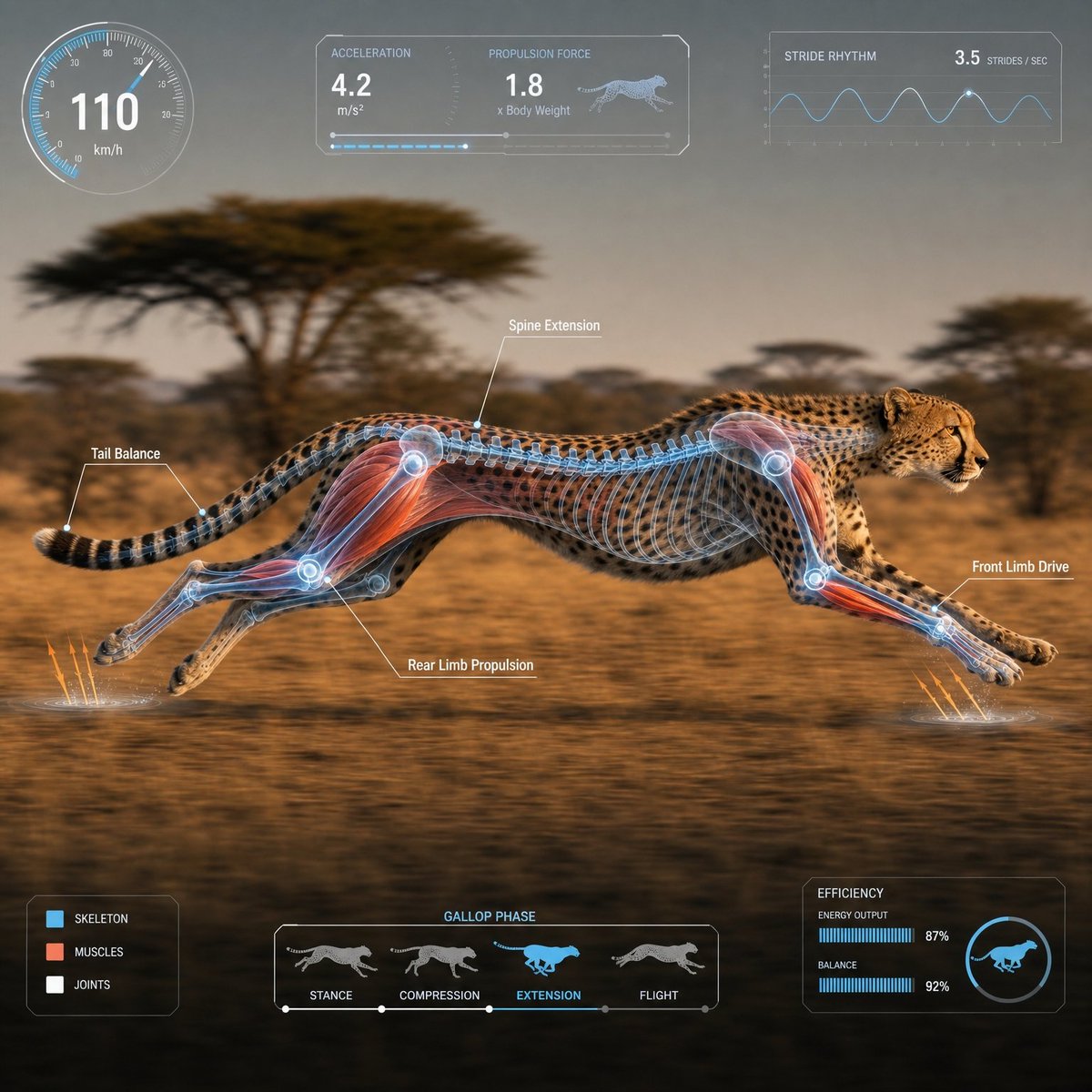
Scientific Animal Motion Analysis HUD
views1,400
likes36
comments0
shares3
bookmarks0
quotes1
Translated
1:1 square composition. For video material. High-speed tracking shot from directly sideways, photorealistically depict {argument name="animal name" default="cheetah"} moving in its natural habitat.
Camera is a sufficiently pulled-back medium-long shot. Entire body fully within the frame, composition where major parts like head, torso, legs, wings, fins, tail are not cut off. Subject placed in the central safe area, within 60-70% of the width, with margins on top, bottom, left, and right. Silhouette moving from left to right directly sideways. Background has slight horizontal motion blur, subject is sharply focused.
Overlay a transparent 3D skeleton or appropriate anatomical overlay accurately on the body, emphasizing muscles, joints, spine and torso extension, and propulsion parts like legs, wings, fins, tail. Semi-transparent blue/white base, with red or orange accents only on important parts.
Display a fixed-layout semi-transparent HUD at the screen edges. UI does not cover the subject, same placement every time.
Top left: circular speedometer
Top center: acceleration, force, thrust panel
Top right: stride, flapping, swimming rhythm graph
Bottom left: muscle, skeleton, joint legend
Bottom center: motion phase timeline
Bottom right: energy efficiency, balance mini chart
Annotations up to 4 max. Short English labels only. Clean SF documentary-style UI in white, cyan, light blue. Numerical values can be reference display, avoid long text or crowded UI. Cinematic natural lighting, high definition, photorealistic, organized scientific documentary style.
Elements to avoid: close-ups, body cuts, tail/legs/wings/fins frame out, multiple animals, extra legs, distorted joints, human-like skeleton, unreadable text, crowded UI, large graphs, UI covering subject, excessive light effects.
Machine-translated — the original is what produced this result.


